
Login

Vi har tekniska problem. Din formulär har inte varit framgångsrik. Vi ber om ursäkt och försök igen senare.

Register

Vi har tekniska problem. Din formulär har inte varit framgångsrik. Vi ber om ursäkt och försök igen senare.

Thank you for registering

An email to complete your account has been sent to

Return to the website

get direct access

Fill in your details below and get direct access to content on this page

Text error notification

Text error notification

Checkbox error notification

Checkbox error notification

Vi har tekniska problem. Din formulär har inte varit framgångsrik. Vi ber om ursäkt och försök igen senare.

Thank you for your interest

You now have access to Smart sensors, smart decisions: 3 ways sensors can help improve machine performance

A confirmation email has been sent to

Continue to page

Please or get direct access to download this document

Industry 4.0
Operational Excellence

Smart sensors, smart decisions: 3 ways sensors can help improve machine performance

Publicerat 16 mars 2026 i Industry 4.0

Smart sensors, smart decisions: 3 ways sensors can help improve machine performance

Sensors may be small, but they make the biggest difference on the factory floor. They are the first point of contact between machines and reality. They detect, measure, and validate the physical world so that production decisions can be made accurately and on time.
As manufacturers pursue higher performance and reliability, the goal is not simply to add more sensors, but to make sensing more integrated, more consistent, and more insightful. Here are three ways how integrated smart sensing helps machine builders and manufacturers achieve better control, reliability, and quality.

1. Build stability through precise and adaptable detection

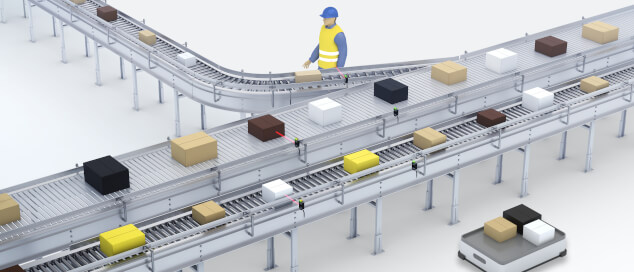
Every process begins with detection — whether identifying a part, confirming a position, or verifying a product’s presence. When detection is inconsistent, the entire system suffers: false triggers, missed signals, and time-consuming manual checks.
Modern optical and displacement sensors combine precision optics with digital intelligence. They automatically adjust to changes in color, surface, or shape and maintain stable readings even in variable environments. This allows machine builders to design lines that work reliably across a wide range of products, without constant recalibration.
A consistent detection foundation improves every step that follows: feeding, positioning, quality inspection, and data capture. The key is that good sensing data is trusted data. Once a sensor delivers stable signals, the machine’s control logic, analytics, and feedback loops can function accurately.
For many machine builders, the pain point is selecting the right sensor for complex materials or reflective surfaces. Newer sensing technologies simplify this process by reducing the number of model variations required, lowering integration risk, and accelerating commissioning. Reliable detection enables predictable delivery and fewer service calls after installation.
2. Use connected sensors to simplify design and maintenance

Machine builders are under pressure to deliver more capability with less complexity. IO-Link communication and integrated sensing architectures are solving this challenge. 

When sensors are connected through open communication standards, they become easier to install, configure, and monitor. Instead of individual analog outputs and manual parameter settings, a single digital interface allows automatic configuration, central diagnostics, and device replacement without reprogramming.

This approach also simplifies maintenance. If a sensor detects contamination, misalignment, or excessive temperature, it can automatically send an alert before downtime occurs. Maintenance teams gain visibility across all devices from a single dashboard, and spare part management becomes easier because configuration data is stored digitally. In addition, IO-Link enables remote troubleshooting, faster and efficient services. This reduces the need for highly skilled engineers to travel onsite for support.

The value for machine builders is clear: faster start-up, fewer wiring errors, reduced commissioning time and easier support. For end users, it means a machine that can self-monitor and communicate issues before they become problems.
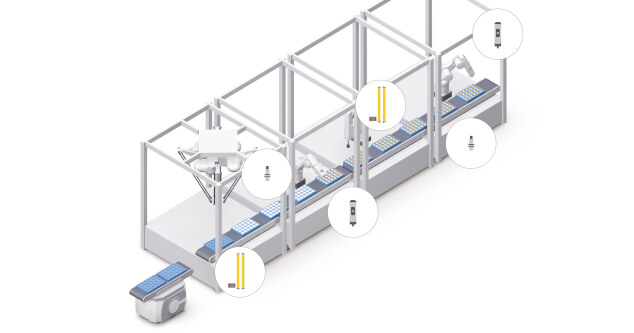
3. Integrate sensing data for process quality and optimization
Sensors generate more than just on/off signals. They produce valuable process data that, when collected and analyzed together, reveals how machines and materials behave in real time. The challenge has always been, how to manage and interpret this information effectively.
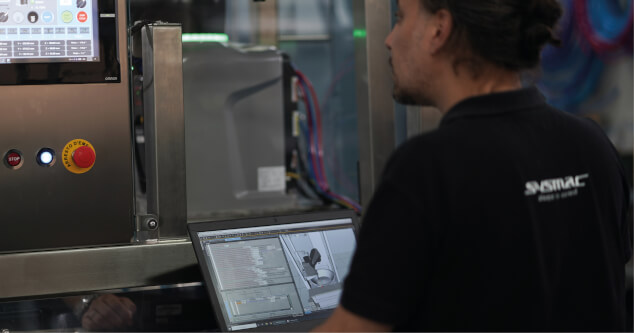
An integrated automation platform, such as OMRON’s Sysmac, solves this by bringing sensing, control, motion, and safety into one environment. Data from photoelectric, displacement, and proximity sensors can be captured, correlated, and visualized alongside temperature, pressure, and flow readings. This unified view allows engineers to identify patterns, verify quality, and adjust processes directly from the control layer — without needing multiple systems or external analysis tools.
For machine builders, this integration reduces complexity at design stage. With one platform managing both sensing and control, there is less risk of incompatibility, and data can flow seamlessly from the field device to the operator interface and higher-level systems. For end users, it ensures that every measurement, signal, and diagnostic is traceable and consistent, forming a reliable foundation for quality assurance and predictive maintenance. 

The benefit of an integrated sensing ecosystem
When sensing technologies are integrated from the start, machines become easier to build, easier to maintain, and more valuable over their lifetime. Instead of treating sensors as add-ons, machine builders can now design them as part of a cohesive architecture — one that connects detection, measurement, and analysis into a single, data-driven system. 
The result is faster project delivery, improved process stability, and reliable data quality for continuous improvement. In the modern factory, smart sensors are the eyes, ears, and sense of touch that make automated decisions possible.

OMRON integrated solutions supporting this approach 

OMRON provides a complete ecosystem for sensing and control, built around the Sysmac automation platform and IO-Link communication.
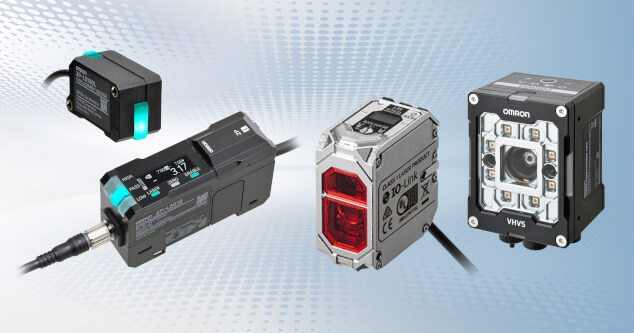
  • Photoelectric detection: E3AS series for short or long-range, color-, material-, and shape-independent detection.
  • Displacement measurement: ZP-L laser sensors for high-precision, adaptive measurement.
  • Proximity sensing: E2E-NEXT series with extended range and diagnostic data for predictive maintenance.
  • Unified integration: Sysmac platform for seamless data flow, configuration, and analytics across devices. 

Together, these technologies allow machine builders to deliver systems that detect any material, communicate with minimal setup, and maintain consistent quality data, turning every sensing point into a source of intelligence.
Discover OMRON’s sensing products: Sensing.
Contact us for more information

Kontakta Omron-specialister

Har du några frågor eller vill du ha råd om något? Kontakta en av våra specialister.
  • Omron Europe

    Omron Europe